
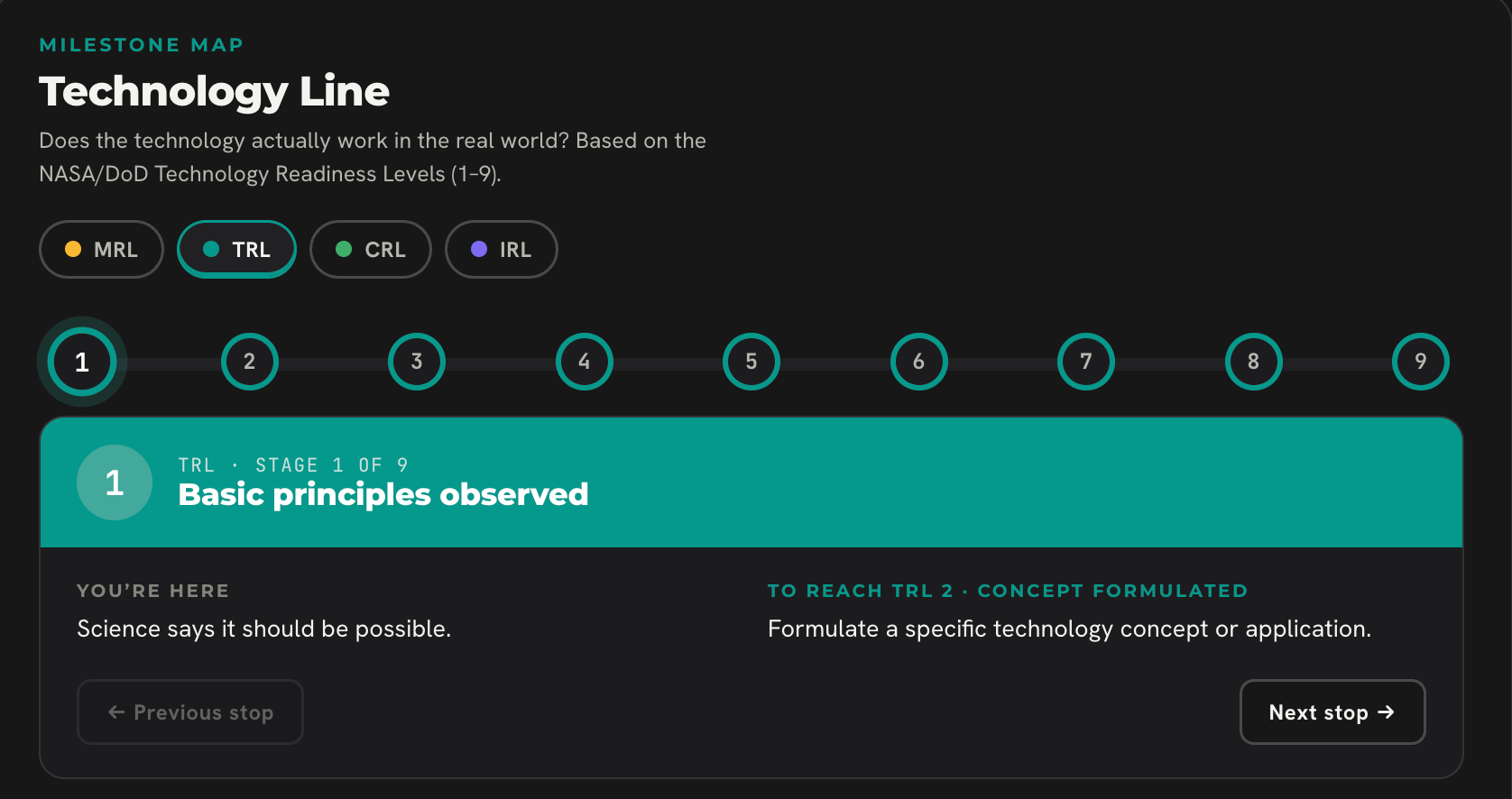
Part of a series on the four readiness scales we use at Lean Rocket Lab.
Technology Readiness Level. Scored 1 to 9.
How proven your product or technology is. Is it a concept on paper, a working prototype, or something running reliably in customers' hands? It tells us whether your next dollar belongs in R and D or in the market.
Where it came from
In 1974, a NASA engineer named Stan Sadin had a communication problem.
NASA was deciding which technologies to put on future missions. Those decisions cost enormous amounts of money and carried real risk, and they were being made by program managers listening to engineers from completely different disciplines describe how far along their work was. The trouble was that everyone used the same words to mean wildly different things. "It works in the lab" could mean a promising simulation or it could mean ready to bolt onto a rocket. There was no shared vocabulary for maturity.
So Sadin built a seven level scale. The question behind it was simple: what has this technology actually demonstrated, and under what conditions? Not how exciting it is, not how much has been spent on it. What has it done, and where.
The scale was formally documented in 1989 and expanded to nine levels around 1990. In 1995, another NASA engineer, John Mankins, published a white paper that codified the nine level system with definitions for each level. Those definitions are still in use today, more than thirty years later, which is remarkable for any framework.
Today TRL is codified in ISO 16290 for space hardware and used as a standard by the US Department of Defense, the European Space Agency, JAXA, and the European Commission, which ties Horizon funding to TRL bands. If you have ever seen a research grant that specifies TRL 3 to 6, that is Sadin's 1974 idea still doing its job.
What the levels actually measure
Here is the part most people miss. Each TRL is not just "how good is the technology." It is a specific combination of two things:
- How complete your prototype is
- How realistic the environment you tested it in.
That second half is what trips companies up. You can build a fully complete system and still be stuck at a low TRL, because you have only ever run it on your own bench, under conditions you control, with you standing next to it.
Roughly, the scale moves like this:
- 1 to 3 is science. Basic principles observed, a concept articulated, then early proof that the concept holds up analytically or experimentally.
- 4 to 6 is the long middle. A component works in a lab. Then it works in a relevant environment. Then a real prototype demonstrates in a relevant environment. Most of the hard, unglamorous work lives here.
- 7 to 9 is proving it in the real world. A prototype in the actual operational environment, then a complete system qualified, then a system proven through actual operations.
TRL 9 in NASA's original language meant "flight proven through successful mission operations." Translated out of aerospace: it works, in the field, for real users, without you.
Why we use it at Lean Rocket Lab
Because "how's the product coming along?" is not an answerable question, and TRL turns it into one.
When a founder tells us their technology is almost ready, that could mean six different things. TRL forces the specific version of the story: what have you built, who has used it, and where. A company at TRL 3 and a company at TRL 7 both describe themselves as "pre revenue with a working product," and they need completely different help.
It also tells us where your next dollar should go. Low TRL means the honest answer is more development, and pushing hard on sales will just generate demos you cannot fulfill. High TRL means the technology is no longer the bottleneck, and continuing to polish it is avoidance rather than progress.
The most common mistake
Overrating yourself.
Almost everyone does it, and not out of dishonesty. It happens because the founder is the most skilled operator of their own product, and every test has quietly been run under favorable conditions. The machine works when you set it up. The software works on the data you cleaned. The process works when you are on the floor.
TRL asks a colder question: has a stranger used this, in their environment, without you? If not, you are lower on the scale than it feels, and that is genuinely useful information rather than a criticism. It means the next milestone is obvious.
What TRL does not tell you
Nothing about whether anyone will buy it.
This is the framework's most important limitation, and it is worth being blunt about. TRL was designed inside an organization that already knew exactly what it wanted and why. NASA never had to ask whether there was a market for the Mars lander. So the scale has no opinion at all about customers, pricing, or demand.
Researchers have pointed out this problem for years, noting that TRL gets criticized most when it is used outside the environment it was built for. A company can reach TRL 9 and have no business, and the scale will happily report a perfect score right up to the end.
That is exactly why we do not use TRL alone. It answers "does it work," and it answers that better than anything else out there. The other three scales answer the rest.
Next in the series: MRL, the scale that asks whether you can actually build a thousand of them.
Curious where you land? Our intake form scores all four readiness scales, and you get the results along with a conversation about what they mean for your
business.