
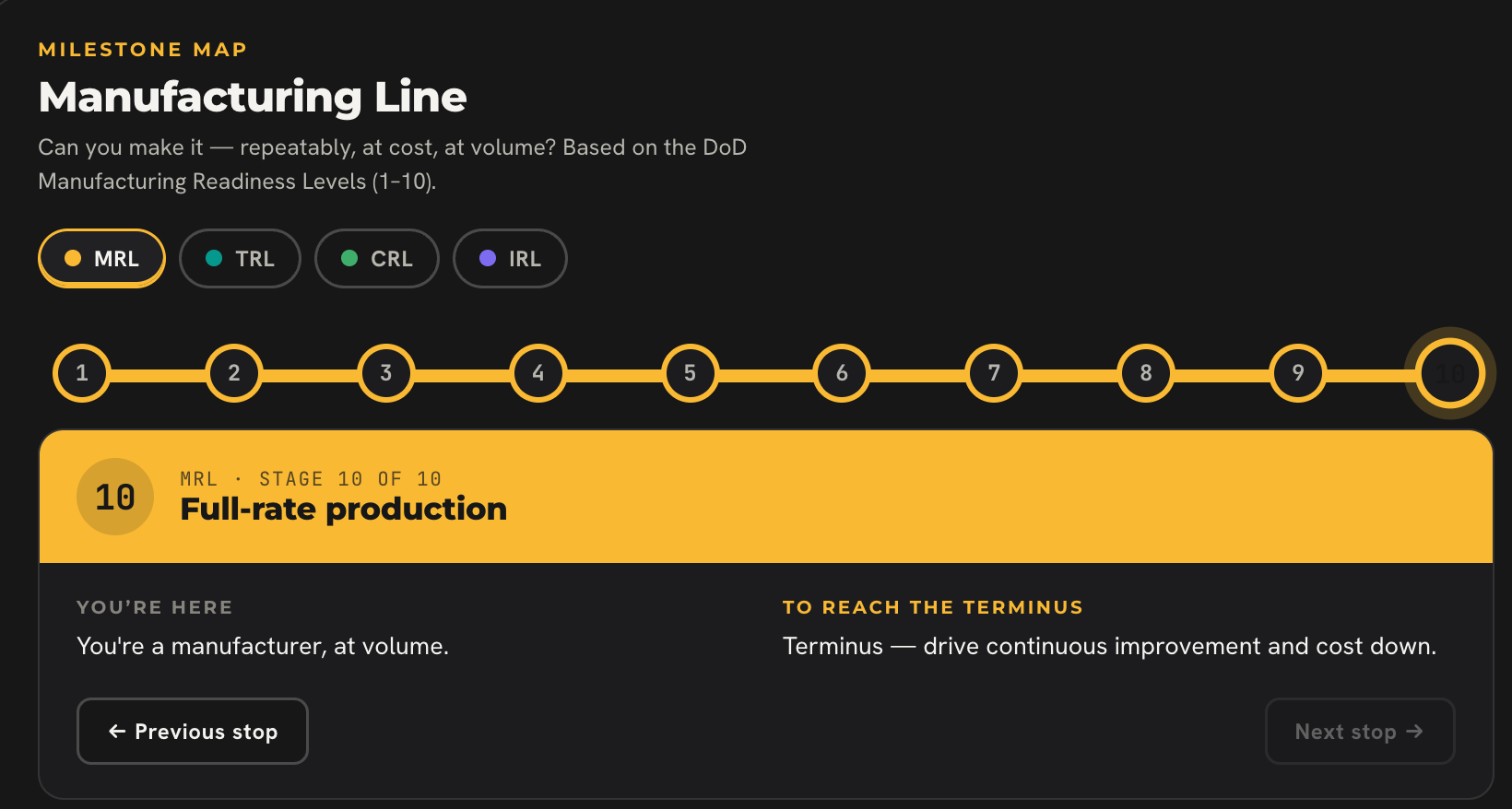
Part of a series on the four readiness scales we use at Lean Rocket Lab.
Manufacturing Readiness Level. Scored 1 to 9.
How ready you are to actually make and deliver your product. Have you figured out suppliers, quality, process, cost, and volume? It is the difference between building 1 and 1,000 without breaking margins or promises.
Where it came from
The US Department of Defense kept running into the same expensive surprise.
A program would clear its technology reviews. The engineering worked, the prototypes performed, everyone signed off. Then it moved toward production and fell apart. Suppliers could not hold tolerances at volume. Costs came in nowhere near the estimates. Schedules slipped by years. The technology was never the problem. Making it in quantity was.
The gap was structural. There was a rigorous scale for technology maturity, TRL, and nothing equivalent for manufacturing maturity. So a program could look green on paper while carrying enormous unmeasured production risk.
A joint DoD and industry working group took this on in the early 2000s, and formal definitions were established in 2005, when the DoD adopted MRLs. The framework lives in the MRL Deskbook, which has been revised repeatedly since. Notably, MRL is not attributed to a single inventor the way TRL is attributed to Stan Sadin. It came out of a community of people who had all been burned by the same thing.
The Government Accountability Office has since described using MRLs as a best practice for improving acquisition outcomes.
What it actually measures
MRL is deliberately built to run in parallel with TRL, and the DoD's own scale runs 1 to 10, ending at full rate production with lean practices in place. We score it 1 to 9 alongside our other scales.
What makes MRL more interesting than a single number is what sits underneath it. An assessment looks at nine separate dimensions, called
threads:
- Technology and industrial base. Can the supply base actually support you?
- Design. Is the design stable, and is it designed to be manufactured?
- Cost and funding. Do you understand your real unit costs?
- Materials. Are your materials available, qualified, and sourced?
- Process capability and control. Can your process hold tolerances repeatedly?
- Quality. Do you have a quality system, or do you have inspection and hope?
- Manufacturing workforce. Do the people exist, with the skills, in your area?
- Facilities. Do you have the space, tooling, and equipment?
- Manufacturing management. Is anyone actually running this as a system?
Read that list as a founder rather than a defense contractor and it stops looking bureaucratic. Every one of those is a way a real company gets stuck.
Why we use it at Lean Rocket Lab
Because this is the scale people forget exists, and it is the one that quietly kills companies.
We see it constantly. A founder has a product that genuinely works, real interest from buyers, and no answer at all for what happens when someone orders a thousand units. Not a bad answer. No answer. It has never been the thing in front of them, because the technology was always more urgent and more interesting.
Then a purchase order arrives and everything that was invisible becomes urgent all at once. Suppliers, lead times, tooling, quality escapes, cash tied up in inventory. That is not a technology problem and no amount of engineering fixes it.
The DoD has a phrase for the fix: moving manufacturing left. Think about production earlier than feels necessary, while design decisions are still cheap to change. Their own guidance is explicit that high TRL with low MRL introduces serious cost, schedule, and performance risk, and that both should be considered early and in parallel.
For a small manufacturer in Jackson, moving manufacturing left might just mean calling three suppliers before you finalize a design instead of after. It is the same principle at a different scale.
The most common mistake
Assuming that because you have built one, you can build many.
Building one is a craft problem, and founders are usually good at craft. Building a thousand is a systems problem: process control, supplier management, quality, workforce, cash. Those are different skills, and being excellent at the first tells you almost nothing about the second.
The tell is when someone describes their production plan entirely in terms of equipment. "We just need another machine." Sometimes true. More often the constraint is the eight other threads nobody has looked at.
What MRL does not tell you
Whether the product is any good, and whether anyone wants it.
You can have superb manufacturing readiness for something nobody is going to buy. Plenty of companies have built beautiful, efficient production capability for the wrong product, and MRL will report a strong score the entire time.
MRL also says nothing about the business around the manufacturing. A shop can run a tight, capable process and still have one person who knows how everything works and no cash reserve.
That is why we score four things instead of one. MRL answers whether you can make it and deliver it. That question deserves its own number, because it is a
completely different problem from whether the technology works.
Next in the series: CRL, the scale that asks whether anyone will actually buy it.
Curious where you land? Our intake form scores all four readiness scales, and you get the results along with a conversation about what they mean for your business.